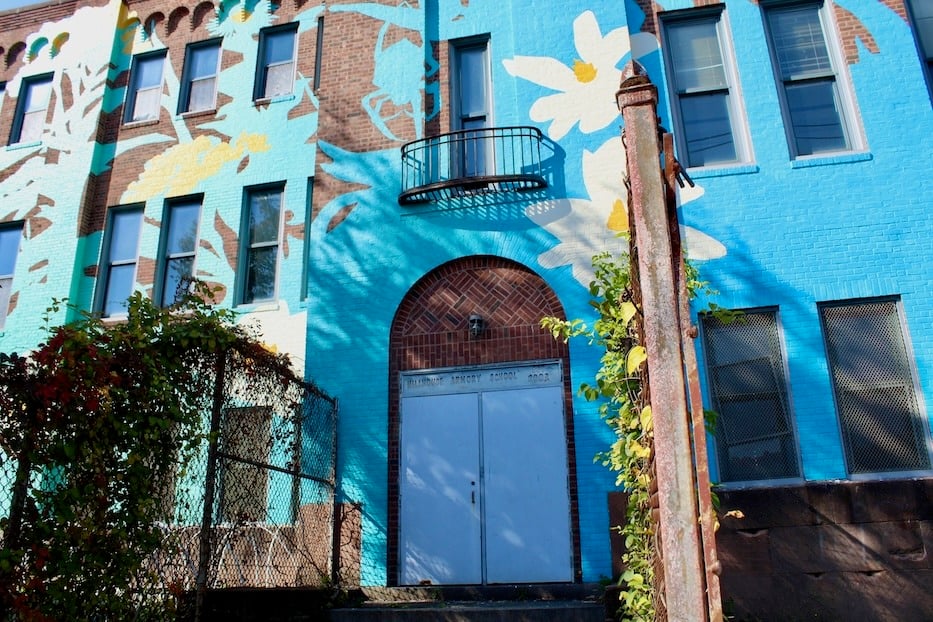
New Haven Armory
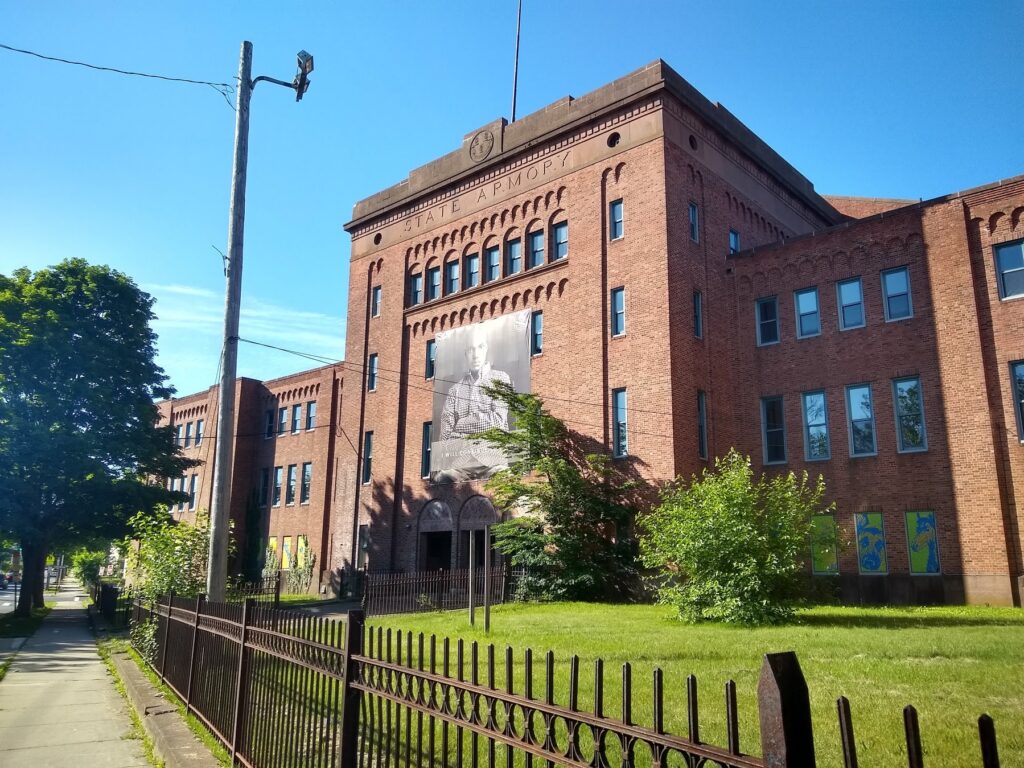
The New Haven Armory on Goffe Street is significant under its role in the “second revolution” of African American civil rights movement from 1964-1976, referencing those events that occurred after the passage of the 1964 Civil Rights Act (which includes the Black Power movement). It achieves this first through its association with events associated with Black Panther organization around the trial of its leaders in New Haven, followed by efforts of the Black Coalition of Greater New Haven to achieve economic justice through community and economic development.


The 1969 Murder of Alex Rackley and the Associated Trial
The event centered around the 1969 murder of Alex Rackley, a member of the Black Panther Party, and the subsequent murder trial and protests. At the time, the FBI’s COINTELPRO program was actively infiltrating Black Panther chapters with informers and agents provocateurs. Rackley was falsely accused of being an informer, leading to his abduction, interrogation, and torture by a rogue party member. He was later taken to a field and murdered.

The Arrests and Trial
Following Rackley’s murder, the police arrested not only the perpetrators—two of whom confessed while the third was found guilty—but also Black Panther leaders Ericka Huggins and Bobby Seale, despite no evidence linking them to the crime. Huggins and Seale faced trial, with the government seeking the death penalty. The case became a focal point for nationwide protests and ignited debates over whether Black revolutionaries could receive fair trials in America. Even Yale’s president at the time expressed skepticism about the fairness of the trial. The proceedings ultimately ended in a mistrial due to a deadlocked jury, with a judge—despite his prior opposition to civil rights figures—siding with the Panthers.
Geoff Street Armory Excerpts from the National Register of Historic Places nomination:
“The period of significance runs from construction of the Armory in 1930 to 1979. It meets Criteria Consideration G for its association with the events surrounding the Black Panther rally and the annual Black Expo, sponsored by the Black Coalition of New Haven, held there through the 1970s. The period of significance extends through 1979 because of these activities.” (page 13)
“Criterion Consideration G: Properties that have Achieved Significance within the last 50 years
The New Haven Armory on Goffe Street is additionally significant under Criterion A with Criteria Consideration G for its role in the “second revolution” of African American civil rights movement from 1964-1976, referencing those events that occurred after the passage of the 1964 Civil Rights Act (which includes the Black Power movement).45 It achieves this first through its association with events associated with Black Panther organization around the trial of its leaders in New Haven, followed by efforts of the Black Coalition of Greater New Haven to achieve economic justice through community and economic development. The Black Power Movement focused on fighting police brutality and aimed to empower Black communities after the passage of the Civil Rights and Voting Rights Acts of 1964 and 1965. At the same time, these later local, regional, and nationally consequential events at the building in the 1970s expands its historical significance to New Haven’s African American community as the site of political, economic, and social civil rights activism. The events as associated with the armory in particular represented the perceptions of those in federal and state governments that such groups threatened peace and democracy during the Cold War era. Officials often pushed back on radical activities with military force, often employing national guard troops against civilian protesters, and often resulting in violence. Months later, the local African American community claimed the armory space to celebrate Black political and economic achievement.
Following New Haven’s race riots in 1967, which occurred in close proximity to the Goffe Street Armory in the Dixwell and Newhallville neighborhoods and in which National Guardsmen intervened, protestors concerned about racial justice organized the “May Day” rally in the city on May 1, 1970. The May Day rally was one of the most significant events of the later civils rights and Black Power movements as civil rights protests merged with white youth and anti-war activism. Across the country during the late 1960s and early 1970s, national guard troops deployed to control these anti-war and civil rights protests. Many of these actions ended in tragic violence, such as the shooting at Kent State University in Ohio during an anti-war protest on campus (site listed on the National Register in 2010) a few days after the events of May 1 in New Haven.
The purpose of the “May Day” rally near the downtown New Haven Green was to raise money and support eight members of the para-military group known as the Black Panther Party, including co-founder and leader Bobby Seale, who were facing murder and kidnapping trials.48 The New Haven Black Panther Defense Committee and supporters believed that the accused could not get a fair trial at the Superior Court in downtown New Haven (listed on the National Register in 2003). The city anticipated over 20,000 people to attend, of all races. Nationally known white peace activists Abbie Hoffman and Jerry Rubin, of the Youth International Party (Yippies), beat-poet Alan Ginsberg, Students for a Democratic Society’s Tom Hayden, and famed pediatrician and New Haven native Dr. Benjamin Spock brought the protest even more notoriety. Students at Yale University, with the support of University President Kingman Brewster, Jr. and many members of the faculty, went on strike in support of the rally. They voted to offer food and shelter to rally participants and serve as crowd marshals. While Yale welcomed the protesters and worked to ensure a peaceful rally, the highly visible military build-up at the Goffe Street Armory contradicted such efforts. The events at the armory mirrored how gathering would result in violence and riots.
The New Haven Armory on Goffe Street served as “ground zero” for the state and federal governments’ response to radical groups like the counter-culture and Black Power movements, who they characterized as militant enemies of the state. Anticipating violence on May 1, 1970, and with the urging of United States President Richard Nixon and Vice President Spiro Agnew, Governor John Dempsey activated the New Haven Grays, the armory’s 102nd regiment. The guardsmen assembled at the armory as “Task Force Bravo” to support local and state police in guarding against rioting during the Black Panther rally. The rally was happening less than two miles away at the New Haven Green and the Yale University campus. Guardsmen from Waterbury, Stamford, and Greenwich joined the 102nd to total 3,000, with more standing by in Branford. Superiors provided the troops with ammunition, gas grenades, and instructions to expect over 50,000 people and not to hesitate to use weapons (if they felt necessary) as officers of the state. The Governor had the authority to order all troops to action at the request of the mayor. Still acting on rumors of potential violence, Governor Dempsey requested an additional 4,000 federal troops (army paratroopers and marines) from North Carolina who were stationed in Chicopee Falls, Massachusetts, while the marines went to Quonset Point Naval Air Station in Rhode Island. The military set tanks and armored vehicles on roads leading into New Haven on the morning of May 1. The rally that day drew only isolated instances of vandalism. As protesters grew frustrated with the military presence, they began throwing bottles at guardsmen. Police employed tear gas on the crowds in response.50
In spite of the military build-up of state and national forces, university and local community efforts to maintain calm at the protest rally adjacent to Yale University proved successful, even just fifteen days after violence on Harvard University’s campus, and four days before the infamous shooting of four students at Kent State University in Ohio. Some observers, including historians, have characterized the military build-up as an attempt by the Nixon administration, urged by J. Edgar Hoover’s Federal Bureau of Investigation, to actually provoke violence and turn national sentiment against groups it perceived as militant and dangerous, like the Black Panthers. After the rally, about 500 of the 3,000 guardsmen remained assembled in New Haven for the remainder of the murder trials.
Only two years later, the local Black community appropriated the New Haven Armory, also known as the Goffe Street Armory, as a space to celebrate and promote African American culture and entrepreneurship. The Black Panther trial and May Day rally provided impetus for other groups in New Haven to address the inequality that the Black Panthers stressed, especially the need for community services and economic programs. While the Black Panthers advocated for nationalism, opportunity and economic independence (but without disavowing violence), the African American civil rights and Black Power movements encompassed many different factions and strategies toward achieving equality. African American leaders from nearly twenty community groups, including the NAACP, the Urban League, and the Hill Parents Association (HPA), united under the moderate Black Coalition of Greater New Haven following the riots in 1967. The Coalition worked successfully to maintain calm in the community following events like Martin Luther King Jr.’s assassination and the May Day rally. In 1972, the Coalition organized the annual “Black Expo,” at the New Haven Armory on Goffe Street. The Expo was a satellite cultural event reflective of similar events in cities across the United States throughout the Black Power era.
The group was inspired by Chicago’s Black Expo, a promotional festival at which African American products, businesses, and culture were featured. In 1971, the Reverend Jesse Jackson left the Southern Christian Leadership Conference, the civil rights group in which he worked alongside Martin Luther King Jr. in its economic unit, over a disagreement about how to incorporate the Black Expo event. Under the philosophy of “civil economics,” Jackson organized expositions in Philadelphia, New York City, and Chicago under a new organization known as PUSH (People United to Save Humanity) with similar economic and political goals expressed by the Black Coalition of Greater New Haven group: “The business of America is business and we, as blacks, want to become part of that business.” While the press characterized these events as politically controversial in other cities, New Haven’s organizers largely avoided those descriptions and the press focused on the Black Expo’s goals of economic development.
The Black Expo brought Black people together from across New England to the New Haven Armory for three days to discuss and advance common economic, political, and social concerns from across the spectrum of African American civil rights movement activities. In addition to formulating a strategy for the 1972 elections, Expo leaders also hoped that the event would help introduce Black businesses to major corporations and create sustainable working partnerships.
The annual event, which recalled the World Fairs of the early 20th century that featured, promoted, and celebrated cultural, economic, and political advances of nations, attracted thousands to the Goffe Street Armory until the 1970s, when such civil activities began to wane. The first Expo in 1972 honored Dr. Martin Luther King, Jr. and included several seminars, such as one on health care and the prison system, for 30,000 people. The next year in 1973, the event was focused exclusively on business and jobs, and featured Republican Senator Lowell Weicker. Approximately 50,000 people attended. Jr. By 1977, attendance fell to about 15,000.” (pages 21-25)
This site is open to the public.