30th ANNUAL VENTURE SMITH DAY CELEBRATION TO BE HELD ON
-
Date
September 12, 2026
-
Time
1:00 pm - 4:00 pm
-
First Church Cemetery
499 Town State, East Haddam, CT 06423
SATURDAY, SEPTEMBER 12th
FROM 1:00 P.M. – 4:00 P.M.
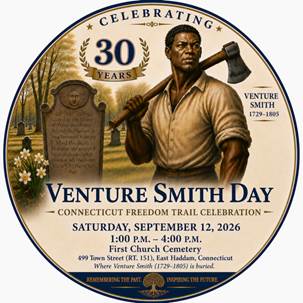
Image of Venture Smith in the logo is a historical artistic interpretation based on written documentation of Venture Smith. No images have been found to date. (Logo design: Susan R. Waide)
EAST HADDAM, CT – The 30th annual Venture Smith Day Connecticut Freedom Trail Celebration will be held on Saturday, September 12th from 1:00 p.m. to 4:00 p.m. in the First Church Cemetery, 499 Town Street (RT. 151), East Haddam, Connecticut where Venture Smith (1729-1805) is buried. Please bring a chair or blanket to sit on and umbrella for shade if sunny. If raining the event will be held inside of the First Church of Christ Congregational. Exhibits and refreshments will be served following the event in the Church’s Fellowship Hall.
Son of an African king, Venture Smith (Broteer Furro) became the first Black man to document his capture from Africa and life as an enslaved person living in colonial Rhode Island, New York, and Connecticut and as a successful Black freeman in Connecticut. Well-known and respected, Venture Smith spent most of his freedom years in Haddam Neck and East Haddam, Connecticut. His grave, at First Church Cemetery in East Haddam, is one of the original sites on the Connecticut Freedom Trail.
The following is information about this year’s speakers.
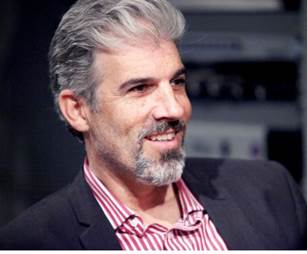
Dr. Matthew Warshauer, a Professor of History at Central Connecticut State University, and a nationally recognized scholar of American political and constitutional history, will talk about how “The American Revolution was Fueled by Sugar: Connecticut as the Provisions State.” Connecticut is well known as the “Provisions State.” Though a small colony, it served an oversized role in supplying General George Washington’s army during the American Revolution. Without that support, both in terms of actual supplies and logistics, it is questionable if the fledgling rebellion could have been sustained in its first year. But what placed Connecticut in such an advantageous role for supplying the army? All the colonies were agricultural. How was Connecticut different? The answer? Sugar.
A dedicated educator, Dr. Warshauer has received numerous university honors, including the Central Connecticut State University Distinguished Service Award, the institution’s highest recognition, the 2022 Excellence in Teaching Award, and most recently he was named a Connecticut State University Distinguished Professor of History Award. He is the author of six books, including Andrew Jackson and the Politics of Martial Law, along with extensive scholarship on slavery, the Civil War, and the cultural and political impact of 9/11.

Dr. David J. Naumec, American military historian, battlefield archaeologist, and museum professional specializing in early American social history, conflict archaeology, and the military service of Native and African Americans in New England will talk about “Connecticut’s Indigenous Troops: Army, Navy, & Marines 1775-1783.”
Dr. Naumec currently serves as Museum Manager for Historic Stonington, overseeing the 1840 Lighthouse Museum and the 1850 Palmer House Museum. Previously, he spent more than a decade as Senior Historian and Archaeologist at the Mashantucket Pequot Museum & Research Center.
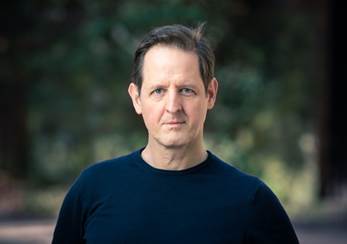
Dr. John Wood Sweet is an award-winning historian, author, and Professor of History at the University of North Carolina at Chapel Hill. He will present “Venture Smith and the American Revolution.” A specialist in early American history, he focuses on the social and cultural histories of race, slavery, gender, and everyday life in colonial and Revolutionary America. Sweet earned his B.A. from Amherst College and his Ph.D. in History from Princeton University.
He is the author of The Sewing Girl’s Tale: A Story of Crime and Consequences in Revolutionary America, which received numerous honors, including the Bancroft Prize, and Bodies Politic: Negotiating Race in the American North, 1730–1830, a finalist for the Frederick Douglass Book Prize. His scholarship has also explored the life and legacy of Venture Smith and the experiences of African Americans in early New England.
Through his research and writing, John Wood Sweet brings to life the stories of ordinary people whose experiences help illuminate the complex history of early America.
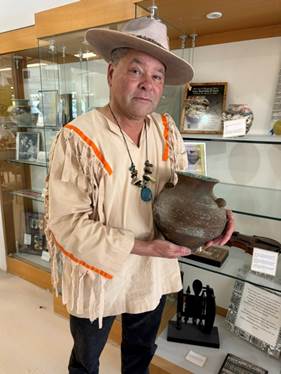
Gary Red Oak O’Neil, Wangunk Elder & Historian, teacher, and potter will talk about “Employment and How It Affected the Smith and Wormsley families in 1940.”
Red Oak is also a descendant of Venture’s through marriage. He works to restore the historical narrative of the Wangunk, ensuring their heritage is integrated into local civic initiatives, such as the riverfront revitalization projects in Middletown. With a career spanning over 60 years, Red Oak is a highly influential Indigenous ceramicist whose solo exhibitions such as Excavations at Wesleyan University draw upon his connection to the local land and indigenous history. He has taught at Wesleyan Potters since 1968 and was named Connecticut’s Teacher of the Year in 1999. He collaborates with local organizations, including the display Native American artifacts, share tribal traditions, and help build a dedicated archive of Wangunk history.
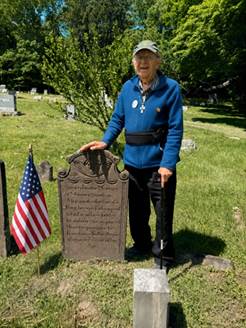
Dr. Karl P. Stofko, East Haddam’s Municipal Historian and Venture Smith family genealogist since the 1970s, will talk about “Cuff Smith, American Revolutionary Soldier.” Dr. Stofko received the 2022 Award of Merit for Individual Achievement from the Connecticut League of History Organizations (CLHO). Hegraduated from the University of Michigan School of Dentistry and from Gettysburg College. Dr. Stofko practiced dentistry from 1965 to 2016. He is co-author of A Brief History of East Haddam, Connecticut. He is presently working on an unabridged two-book series about Venture Smith’s life with author, Susan R. Waide.
Over the years, Dr. Stofko has been the secretary for the East Haddam Historic District Commission and board member for the East Haddam Board of Public Health. He has been the president of the First Church Cemetery Association since 1972. Dr. Stofko is also a member of the Connecticut Freedom Trail Committee and Chairman of the Annual Venture Smith Day Celebrations.
“The Sisters In Stitches Joined By The Cloth” of eastern Massachusetts will return with their magnificent African American quilts. Venture Smith’s family genealogy and family photos and artifacts from their trip to Ghana will be on display. A Town of East Haddam, Connecticut proclamation will be presented. A wreath-laying ceremony by the descendants of Venture Smith and the annual Venture family reunion photograph will take place in the cemetery by Venture’s grave.
Adults and children, who are interested in learning more about Connecticut history in the 1700 and 1800s, are encouraged to attend. For questions, please call (860) 873-9375. To review the original Venture Smith autobiography, go to www.docsouth.unc.edu/neh/venture2/menu.html
Brief Biography of Venture Smith
Born around 1729, Venture Smith’s African birth name was Broteer; and he was the eldest son of King Saungm Furro of the tribe of Dukandarra in Guinea, West Africa. He was captured about 1736 when he was seven years old and sold for “4 gallons of rum and some calico” at Anomabo on Africa’s Gold Coast to Robinson Mumford, the steward of a Rhode Island slave ship commanded by Captain James Collingwood. Broteer was renamed Venture because he was purchased by Mumford’s own private venture. Venture grew up as a slave on Fishers Island, New York, which was being leased by the Mumford family at that time.
Around 1750 he married Meg, another Mumford slave, and they had four children. After a failed escape attempt in 1754, Venture was sold to Thomas Stanton II of Stonington Point, Connecticut. In 1760, he was purchased for the last time by Oliver Smith, of Stonington. Smith allowed Venture to purchase his freedom in 1765 and in return Venture took the name Smith as his surname.
Venture then lived and worked on Long Island to raise money to purchase the freedom of his wife and children. During these years he cut wood, farmed, fished, and spent seven months on a whaling voyage. In 1774, Venture sold all his land on Long Island and in Stonington and moved his family to East Haddam, Connecticut. He then began purchasing land on Haddam Neck along the Salmon River Cove from Abel Bingham and others. His farm grew to 134 acres with three houses; twenty boats, canoes and sailing vessels; two fishing businesses and a commercial orchard. His entrepreneurial ventures included river trafficking, lumberjacking, carpentry, and farming. All this he accomplished without the ability to either read or write.
In 1798, Venture dictated his autobiography to teacher Elisha Niles; it was then published in pamphlet form by Charles Holt, editor of the New London Bee. It has been reprinted many times. It is the only slave narrative of the 18th century that recounts life in Africa. His life story has been an inspiration to many over the years. Venture died on September 19, 1805, a highly respected man by all in the Haddams. Venture’s wife, two sons (Cuff and Solomon), and several grandchildren survived Venture at his death. Several of Venture’s descendants from Cuff’s lineage live in Connecticut today. There are no known descendants from Solomon’s lineage.